


The week at a glance
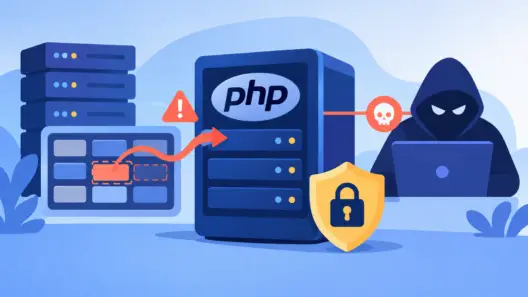
Security dominates this week’s headlines, with PHP2Shell, two critical vulnerabilities exploited across exposed infrastructure, and several warnings about AI assistants capable of leaking secrets or following malicious instructions hidden in files. GitLab, Ivanti and Cisco are also affected by vulnerabilities added to exploited-vulnerability catalogs. On the AI front, falling model costs and the emergence of autonomous agents running directly on smartphones highlight the industry’s rapid transformation. Finally, Python is abandoning its experimental JIT compiler, while GitHub strengthens dependency controls for its workflows.
PHP2Shell: Servers compromised on a large scale
The vulnerabilities CVE-2026-109618 and CVE-2026-109619 can, under certain conditions, allow remote code execution without authentication. PHP versions earlier than 8.5.12, 8.4.27, 8.3.36 and 8.2.35 are affected; PHP 8.1 and older versions require migration to a supported branch. Exploitation is no longer theoretical: Dream Research documents a campaign that compromised 25 servers, including government infrastructure, notably targeting Palo Alto PAN-OS 12.1 and 12.2 appliances running PHP 8.0.30. Administrators should apply both PHP and vendor security updates, then restart the affected processes.
- UK NCSC — Critical security issue affecting PHP — 5/5 — https://www.ncsc.gov.uk/news/critical-security-issue-affecting-php
- Dream Research — Chained PHP2Shell Exploit Roots 25 Servers — 4/5 — https://dreamgroup.com/blog/chained-php2shell-exploit-roots-25-servers
AI agents: Your secrets are no longer safe in your repository
Development assistants are becoming a new attack surface. Experiments show that a simple log file containing malicious instructions can hijack the behaviour of several models. This is known as indirect prompt injection. Another issue is that secrets can be transmitted to AI assistants through test logs, environment variables or configuration snippets, without ever being committed to Git. Sensitive information must therefore be treated as exposed whenever it enters the context provided to an AI tool.
- DEV Community — Ghost in the Shell: Can a Log File Hijack an AI? — 3/5 — https://dev.to/gramli/ghost-in-the-shell-can-a-log-file-hijack-an-ai-3gk
- DEV Community — Your secrets don’t need a git commit to leak into an AI tool — 3/5 — https://dev.to/cyclopt_dimitrisk/your-secrets-dont-need-a-git-commit-to-leak-into-an-ai-tool-be2
AI: Lower prices and autonomous agents
OpenAI and Anthropic’s API prices have fallen sharply, by up to 80% according to an analysis published this week. This makes applications that previously required substantial budgets much more affordable. Meanwhile, Mika illustrates another emerging trend: this open-source Android agent can interact directly with apps and the web from the device itself. Finally, a comparative study reminds us that an older specialised model can outperform general-purpose LLMs on a specific medical task: specialisation still matters.
- GitHub — wangzan101/Mika — 5/5 — https://github.com/wangzan101/Mika
- Max Woolf — OpenAI and Anthropic cut their LLM prices by up to 80% — 3/5 — https://minimaxir.com/2026/10/cheap-llms/
- Lynch Lab — A 10-year-old CNN outperforms frontier LLMs — 3/5 — https://lynchlab.net/llm-skin-cancer
Critical vulnerabilities: GitLab, Ivanti and Cisco under scrutiny
Several vulnerabilities have now been listed as actively exploited. CVE-2026-97229 allows unauthenticated code execution on GitLab CE/EE versions earlier than 19.2.8, 19.3.5 and 19.4.2; these patched versions should be installed. CVE-2026-118527 affects Ivanti Connect Secure, including versions earlier than 25.1.1.3, 25.1.3.1 and 22.8R2.6; apply the corresponding security updates. Finally, CVE-2026-76418 affects Cisco ASA and FTD in certain VPN configurations; Cisco has released patches for the affected branches. These appliances should be treated as high-priority maintenance targets.
- GitLab — Critical Patch Release 19.4.2, 19.3.5, 19.2.8 — 5/5 — https://docs.gitlab.com/releases/patches/patch-release-gitlab-19-4-2-released/
- Government of Canada — Ivanti security advisory — 5/5 — https://www.cyber.gc.ca/en/alerts-advisories/ivanti-security-advisory-av26-1035
- Cisco — Secure Firewall ASA and FTD Vulnerability — 5/5 — https://www.cisco.com/c/en/us/support/docs/csa/cisco-sa-asaftd-tunnel-dos-s6mgkb75.html
Python abandons its experimental JIT
After several years of development, the CPython Just-In-Time (JIT) compiler project has suffered a major setback. PEP 836, intended to define the conditions for integrating this technology sustainably, was withdrawn on October 19. Maintainers were unable to establish a satisfactory framework for maintenance, compatibility and cross-platform support. This decision does not undermine Python itself, but highlights how difficult it can be to integrate such a complex optimisation into such a widely used ecosystem.
- LWN — Python’s experimental JIT to be removed — 4/5 — https://lwn.net/SubscriberLink/1102102/0c00e4d550f25f8c/
- Python — PEP 836: JIT Go Brrr — 5/5 — https://peps.python.org/pep-0836/
GitHub Actions: Locking dependencies is not enough
GitHub is introducing a lockfile mechanism for Actions workflows, allowing dependencies to be pinned to specific commits, including indirectly referenced dependencies. The goal is to prevent a later change to an external tag from silently changing the code executed during a deployment. However, locking a dependency does not guarantee that it is safe. Developers still need to review the actions they use, control updates and integrate scanning tools such as Trivy to detect vulnerabilities in Docker images.
- Medium — GitHub Actions Got a Lockfile on October 14 — 3/5 — https://medium.com/@andy.a.g/github-actions-got-a-lockfile-on-october-14-it-locks-the-code-you-reviewed-it-does-not-review-it-405e84383ffb
- Medium — How to Scan Docker Images for CVEs with Trivy — 3/5 — https://medium.com/devops-ai-decoded/how-to-scan-docker-images-for-cves-with-trivy-complete-guide-07b0b209a063